What People Are Discussing About Marketing Today: An Analysis of Open Threads Data
What are people saying about marketing right now? An analysis of nearly 10,000 Threads posts, and the main trends in the Kazakhstan market.

To understand how people actually talk about marketing, we at gro.now exported and analyzed nearly 10,000 public Threads posts that mentioned marketing topics: “marketing”, “marketer”, “SMM”, “advertising”, “targeting”, “content”, “brand”, “funnel”, “leads”, “sales”, “AI”, “neural networks”, and related wording.
What follows is what people write themselves: in their own words, with their own frustrations, jokes, and complaints.
In short: marketing is no longer discussed as the production of a “pretty picture”. Today people talk about it through results — inquiries, sales, trust, and reputation. The market for marketing services, and the way the marketer’s profession itself is understood, have entered a more mature phase.
How much data we collected
Before the analysis, we cleaned the dataset: we removed duplicates and content that clearly referred to other countries.
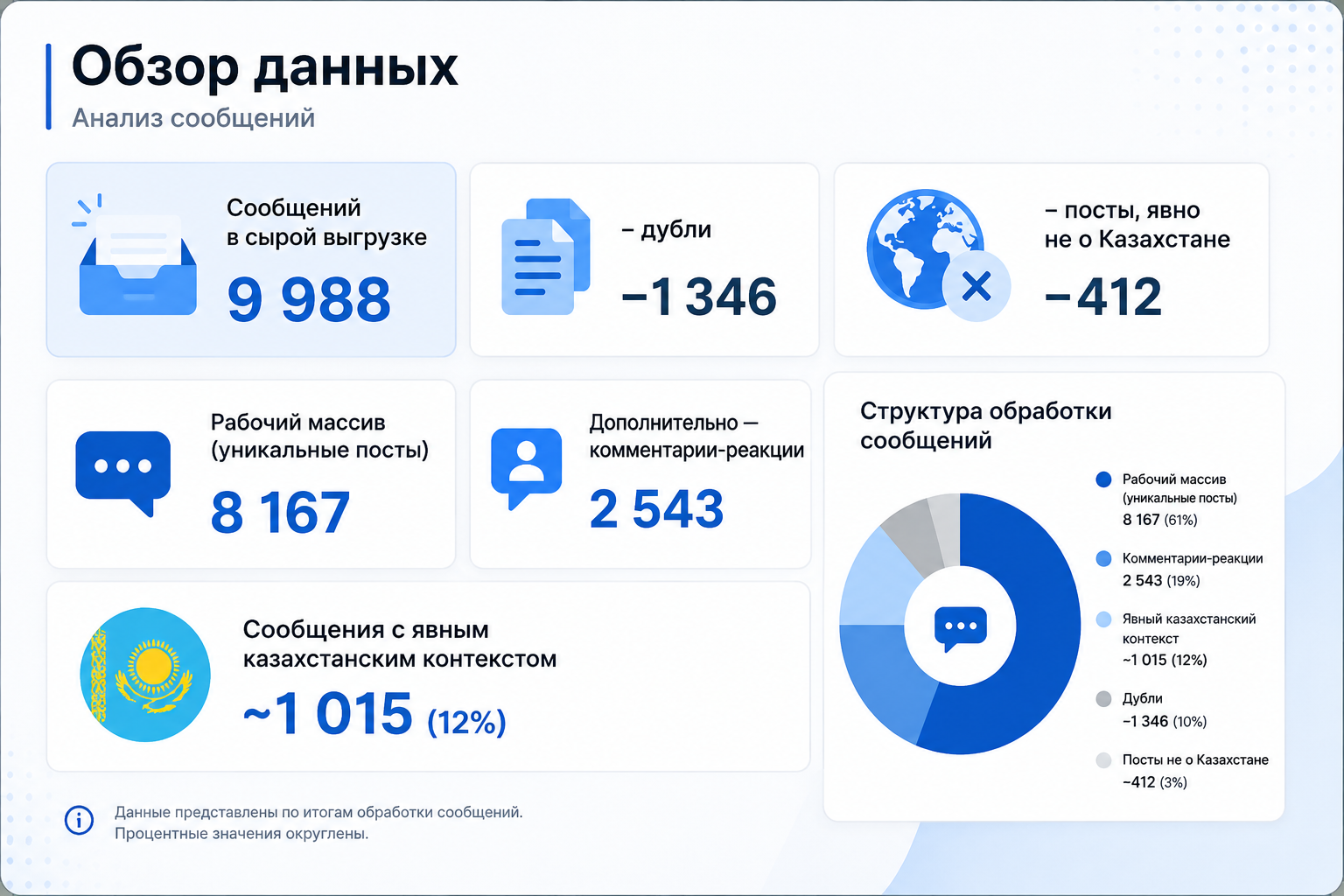
The working dataset collected 2.29 million likes. That let us look not only at which topics appear most often, but also at which ones draw the strongest response.
An important caveat: not every post names a country directly. Some are clearly about Kazakhstan — Almaty, Astana, the tenge, Kaspi, the Kazakh language, local brands. Others are general Russian-language content about marketing. So we are honest about what this is: a study of the marketing conversation in the Russian-language and Kazakhstani Threads information space, not a representative survey of the whole market.
Another finding from the structure of the data: opinion lives in posts, not in comments. Posts account for 2.29 million likes, while comments account for 15 times fewer likes (a typical comment has 1 like). People are not so much arguing in the replies as speaking up in the post itself — and then that post gets shared further.
The main finding: marketing is discussed through results
The most visible theme in the data is marketing as a sales tool. People are not talking about “attractive packaging”. They are talking about leads, inquiries, funnels, budgets, targeting, reach, conversion, and whether the spend actually pays back.
Advertising, performance, and sales come up most often — in 3,474 posts, 42.5% of the dataset. No other theme comes close in volume.
Marketing is increasingly judged not by “how good it looked”, but by whether it brought customers in and justified the budget.
This is a tectonic shift in perception: creative work with no result is no longer accepted as proof of effectiveness.
What people talk about most when they talk about marketing
Five large themes stood out in the data. The shares are based on 8,167 posts (a post can belong to more than one theme).
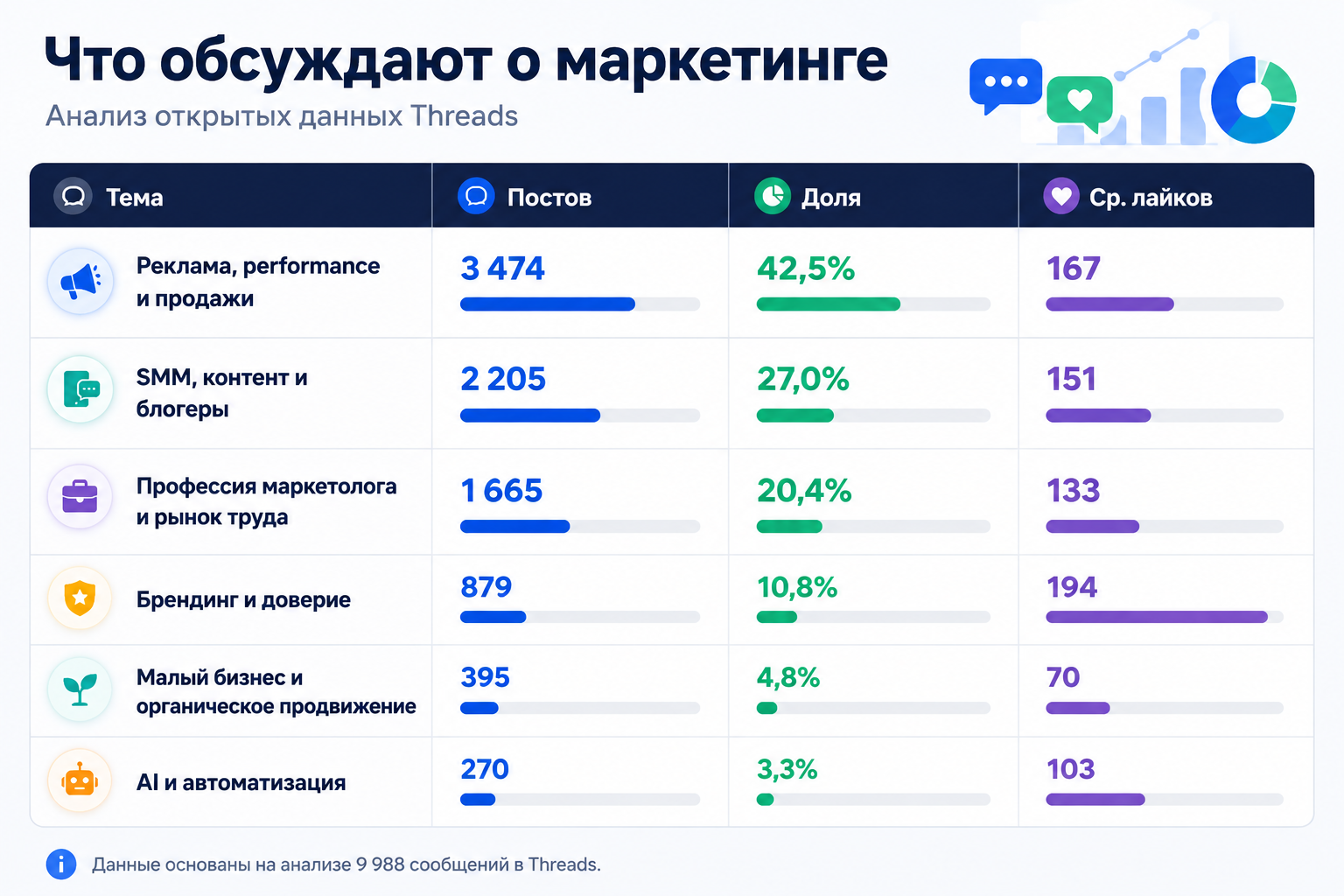
Look at the last column: branding is discussed less than every other major theme, but it earns likes more readily than any of them (194 likes per post, against 167 for performance). People write less about what a brand means — and that is exactly what draws the stronger response. It is a clue to what the audience is actually missing.
Marketing as a profession: expectations have outgrown the role
One of the strongest sections is the image of the marketer. The profession and the labor market came up in 1,665 posts (20%).
In these discussions, a marketer almost never “only runs advertising”. They are expected to do everything at once: strategy, sales, content, targeting, analytics, visual design, product understanding, influencer work, AI tools, and sometimes operations.
In the data, a marketer is someone expected to be a strategist, a creator, an analyst, an SMM specialist, a targeting specialist, and a salesperson at the same time.
That makes the profession look overloaded. And it has a price — literally. In the Kazakhstan slice of the data, the same complaint about pay comes up again and again:
- “You want a salesperson, an SMM specialist, and a Reels creator in one person for 200k? That’s pocket change” — 1,453 likes. 🔗 view
- “Turnkey marketing teams for 200,000 tenge — why are you undercutting the market?” 🔗 view
- “I’m tired of job hunting in Almaty. Two weeks in, and I consider myself a strong SMM specialist”.
A signal for business: when expectations of the role are blurred, conflict is inevitable. The company expects sales to grow. The specialist is handed everything at once and cannot be accountable for every part of the job.
SMM is no longer a channel. It is a business function of its own
In these discussions, SMM is no longer “running Instagram”. It is content, filming, Stories, Reels, Threads, personal brand, influencers, warm-up sequences, and engagement. The theme is 27% of the dataset, second by volume.
What stands out is that small businesses are moving into organic reach more and more often. When advertising is expensive or does not pay back, owners promote themselves through personal pages, Threads, recommendations, and community — with content in the first person.
SMM is no longer a supporting channel. For small businesses it is now the main mechanism for sales and trust — often instead of paid advertising, not in addition to it.
AI is already on the agenda — but without the hype
AI and neural networks are a visible theme, but not a dominant one yet: 270 posts (3.3%) talk directly about neural networks, ChatGPT, generation, and automation. (Counted broadly, including any automation and content generation, the figure reaches about 1,500 — but the conversation that is specifically about AI is still more modest.)
The attitude is ambivalent. On one side, AI is an assistant that speeds up the work. On the other, there is anxiety: if the copy and the visuals are generated automatically, where is the specialist’s value? And there is plenty of irony aimed at lazy AI content:
“When you post AI photos, at least look at them” — 30,013 likes. 🔗 view
The takeaway: in marketing, AI is not yet a revolution or a threat. It is a tool, and a reason for jokes. Value is shifting from producing content toward strategy, taste, and an understanding of the audience — the things AI still does not cover.
The main frustration: marketing promises more than it can prove
There is not much negativity in the dataset — about 4% of posts. But that slice is exactly where the most sensitive points show up. The irritation clusters around the gap between the promise and the reality:
- advertising does not pay back, and targeting does not bring customers in;
- the marketer does not deliver a result people can understand;
- the content feels pushy, and warm-up posts and personal branding wear people out;
- marketing is perceived as manipulation;
- a brand’s attractive promise does not match the product.
The language of this frustration is easy to recognize: “burned the budget”, “it doesn’t work”, “a marketing ploy”, “I fell for the marketing”, “info-product grift”, “a smear campaign”. One of the sharpest complaints about the info-product business: “Every info-product guru selling targeting courses is going to hate me now” — 6,459 likes. 🔗 view
And the most viral gesture of dissatisfaction is escaping ads altogether: “you turn on a VPN, pick Albania — and YouTube has no ads” (14,908 likes). 🔗 view
The audience has become sensitive to any mismatch. If marketing promises more than the product delivers, it immediately becomes a reputational risk.
What counts as good marketing
In the positive discussions (there are three times as many of them as negative ones), good marketing is not “beautiful advertising”. It is:
- promotion that brings customers in;
- content that sounds human;
- plain language and a strong idea;
- a personal brand that earns trust;
- an audience that gets involved on its own;
- a real fit with the local context;
- a promise that matches the experience.
The best illustration is not an advertising budget. It is a detail. Here are the top examples the audience itself, through likes, called strong marketing (every link goes to the original post):
1. “We don’t sell carpets!” — a support account named @kover_center, apparently tired of the requests, posted a cry from the heart that earned 36,258 likes. 🔗 view
2. Dodo and “Have a Dodo day” — an operator’s reply to a customer’s greeting, 47,478 likes. Dodo is the most discussed brand in the dataset, and the sentiment around it is strongly negative. Mentioning the company during a wave of cancellations set off an explosive backlash. Another reminder of how much a human tone matters. 🔗 view
3. Aviasales — “the Aviasales marketing department has been studied 0.000001%”, 10,982 likes. A benchmark for bold SMM that the audience itself holds up as the example. 🔗 view
4. A billboard for a cat — “They bought a billboard. That’s how much the cat means to them”, 16,208 likes. Emotion and a human story, instead of an offer. 🔗 view
The formula for good marketing, according to the data: trust + results + a human detail. The audience supports what does not feel artificial, and what has real value behind it.
Which brands and platforms came up
More often than brands, people name the platforms through which marketing actually gets done today. The order follows how often each one is mentioned in the data:
Brand / platform
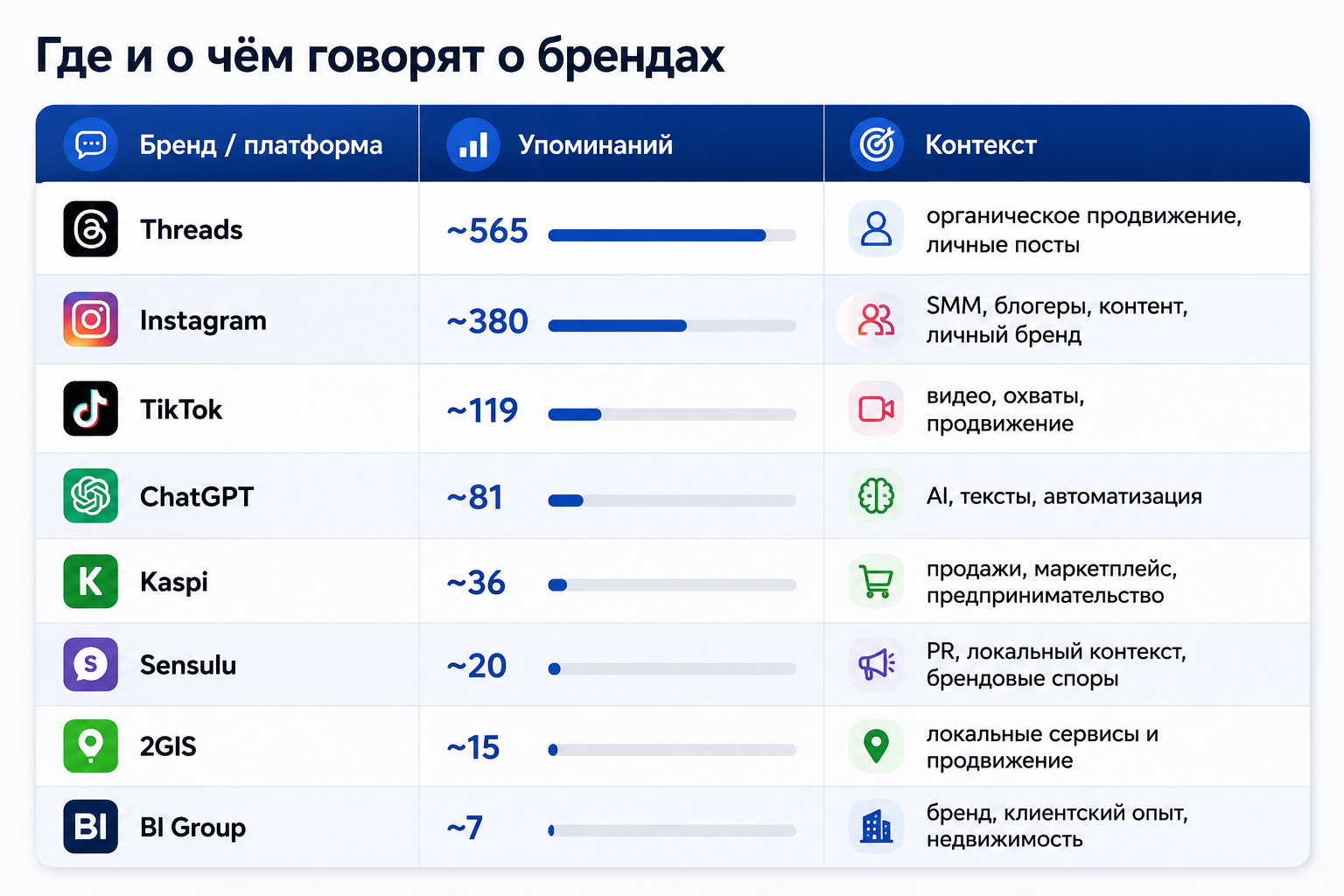 Important: for most brands there is too little data for a ranking of “the best marketing” — many are mentioned only once. The only frequently mentioned Kazakhstani brand is Kaspi, and the tone around it is mixed: both an example of targeting that works and a source of ad fatigue (*“I’m sick of Kaspi ads: one day it’s Juma, the next it’s discounts”* — 🔗 view). A separate local case with numbers is a breakdown of “18 million tenge in turnover on Kaspi in a month” (5,036 likes, 🔗 view).
And one of our favorites, kopsoz_kz, a company that overtook the most discussed brand in reach through persistence and creativity.
A distinct Kazakhstan detail: in the local slice, what spreads further than any ad is language and culture. The most-liked post from Kazakhstan, “In Kazakh, a fan is Желдеткіш”, collected 35,579 likes. 🔗 view
What this means for business
1. Marketing is judged by business results. Attractive content on its own is no longer proof of effectiveness. What matters is inquiries, sales, and payback.
2. Small businesses need organic reach they can afford. A personal brand, a community, and Threads are becoming a real alternative to expensive advertising.
3. The marketer’s role is expanding, and that creates a risk of overload. Companies should be more precise about who they are hiring: a strategist, a targeting specialist, an SMM specialist, a content maker, an analyst, or a team lead.
4. AI changes what the job requires, but it does not remove the profession. Copy and ideas can be automated. Strategy, taste, and accountability for the result are harder.
5. The gap between the promise and the reality is dangerous. If the communication says one thing and the customer experience says another, the backlash lands on both the product and the brand.
Topics worth studying further
- what businesses actually expect from marketers;
- why owners lose confidence in targeting;
- how Threads is becoming a channel for organic promotion;
- how AI is changing the profession;
- why audiences are tired of warm-up content and personal branding;
- which brands are seen as examples of strong marketing;
- how the Kazakh language and local context affect trust;
- how small businesses grow without large budgets;
- where the line sits between marketing, manipulation, and honest communication.
Bottom line
Marketing today is discussed not as a separate function, but as part of the whole business system: it is tied to sales, the product, trust, customer experience, personal brand, AI, and reputation.
The main finding: the audience has become more demanding. Marketing is no longer seen as attractive advertising. People expect honest communication, clear value, and a real result.
For businesses, this means something simple: strong marketing starts not with the creative, but with the promise matching reality. If a brand speaks well but does not back it up with the product and the service, marketing turns from a growth tool into a source of distrust. When it helps explain the value, build trust, and bring the customer in, it stops being a cost and becomes a strategic asset.
Sources: the original posts behind every case
Every link goes to the original Threads post (likes are in parentheses).
Examples from the article
- “We don’t sell carpets!” — @kover_center (36,258) — https://www.threads.com/@kover_center/post/DV8VUcgiBNZ
- “Have a Dodo day” — @iardanec, the Dodo case (47,478) — https://www.threads.com/@iardanec/post/DVF8ruXDUEB
- “The Aviasales marketing department has been studied 0.000001%” — @gioks.rabon (10,982) — https://www.threads.com/@gioks.rabon/post/DZyfFAwCCrw
- A billboard for a cat — @araiiq (16,208) — https://www.threads.com/@araiiq/post/DYaMK7wCMH6
- “The best ad for the @taptatti pastry shop” (1,723) — https://www.threads.com/@gigantskij_zhuk/post/DZ2XIWuiEIf
- “Info-product gurus who sell targeting courses are going to hate me” — @dubovcov.n (6,459) — https://www.threads.com/@dubovcov.n/post/DUiZkO1iNOc
- “A salesperson, an SMM specialist, and a Reels creator in one person for 200k” — @karinameshanskaya (1,453) — https://www.threads.com/@karinameshanskaya/post/DaPY8zRDT8Y
- “Turnkey teams for 200,000 tenge — why are you undercutting the market” — @kizibil (260) — https://www.threads.com/@kizibil/post/DYwBtsdjHX1
- Valya Karnaval as the face of the Sensulu brand — @indira.nabi (8,449) — https://www.threads.com/@indira.nabi/post/DYaczxFjpMA
Kazakhstan context
- “In Kazakh, a fan is Желдеткіш” — @kopsoz_kz (35,579) — https://www.threads.com/@kopsoz_kz/post/DaOM2gljNP4
- “18 million ₸ in turnover on Kaspi in a month” — @cubedemper (5,036) — https://www.threads.com/@cubedemper/post/DZXZpoWAsMj
- Fatigue with Kaspi ads, “one day it’s Juma, the next it’s discounts” — @sofapolitician (661) — https://www.threads.com/@sofapolitician/post/DZ2cXQEDOy_
AI and neural networks
- “When you post AI photos, at least look at them” — @docenk_o (30,013) — https://www.threads.com/@docenk_o/post/DZstZ2liFT-
- “SMM specialists, which AI tools do you use for work?” — @yourpersonaldevil_ (1,006) — https://www.threads.com/@yourpersonaldevil_/post/DU3XyUgCDFv