The Era of Micro-Attention
7 Key Reasons Why Survey Quality Is Declining
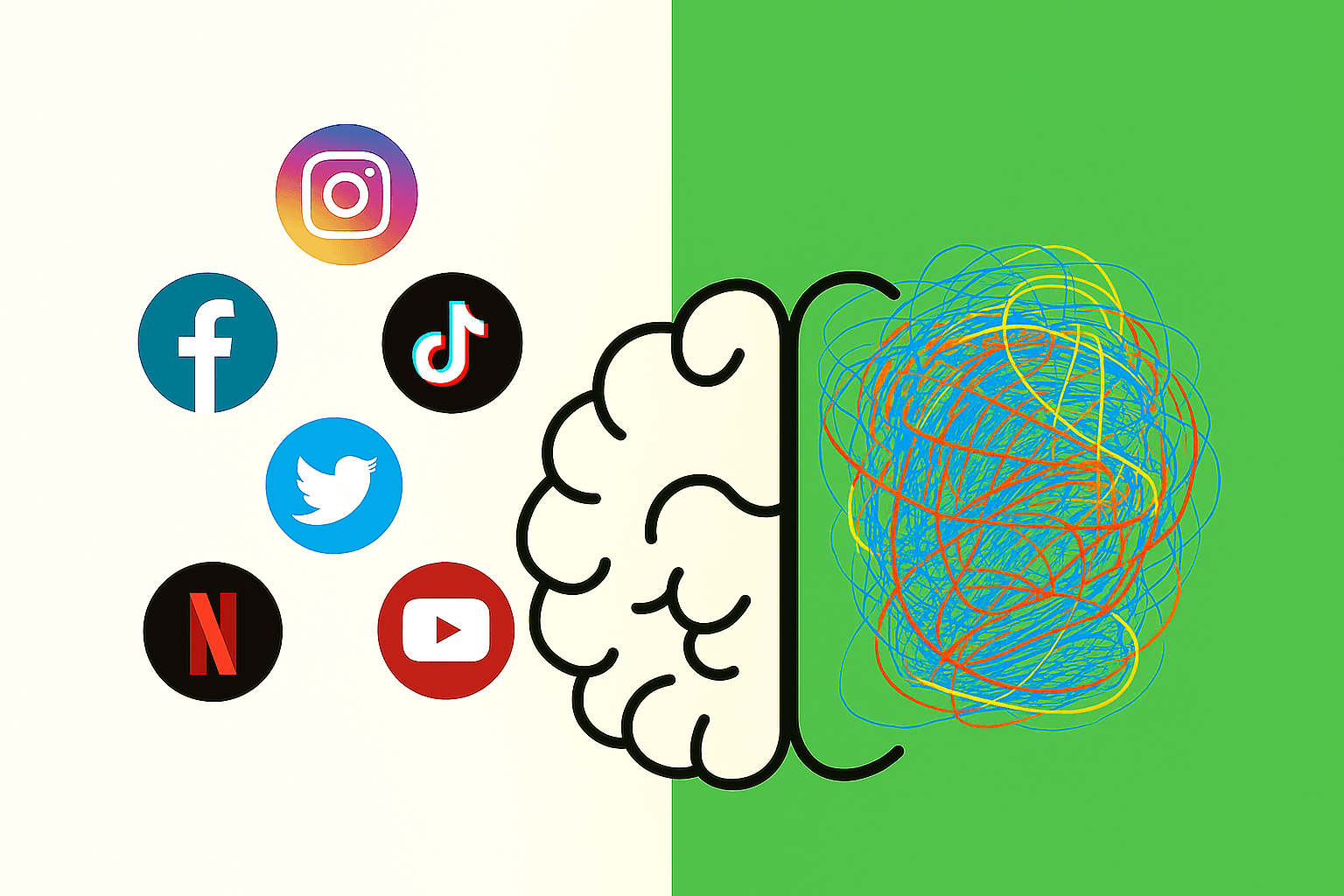
Sometimes it feels like we live in a world where attention lasts even shorter than a phone battery on a freezing day. A person in 2025 is essentially a new kind of human being. We live at a different speed, in a different rhythm, with a completely different way of processing information. We consume content in short impulses, switch tasks instantly, hold dozens of things in mind at once — all while navigating a never-ending stream of digital stimuli.
Nielsen Norman Group gave this phenomenon a name long ago:
the era of micro-attention.
47 seconds.
That’s how long the average person stays focused before the brain moves on.
In this reality, a classic survey — long, linear, static — feels like reading a nine-page instruction manual. You can get through it, technically. But almost never consciously.
At gro.now, we see this every day. We see surveys with 1–3% completion rates, inconsistent answers and distorted data. Not because people don’t care — but because the human brain simply works differently than it did ten years ago.
Here’s what has truly changed, and how we respond to it.
What has changed in people — and why old surveys can’t survive it
1. We no longer hold attention
Our attention span has dropped to the length of a short pause in conversation. If a question doesn’t grab us immediately, the mind slips away.
2. We live in stimulus overload
We process 8–10 thousand informational triggers per day. The brain automatically filters out anything “non-essential.” Surveys often end up in that exact category.
3. We’ve learned to conserve cognitive energy
It’s a survival mechanism. When the brain is tired, it gives fast answers, not honest ones. MIT classifies digital forms as a load on working memory — and that load is heavy.
4. We no longer rely on internal memory
The phone has become our external hard drive. We store emotions — not details. So a question about “yesterday’s experience” often becomes a question about today’s mood.
5. We expect conversational interaction, not questionnaires
Chat interfaces, voice assistants, micro-formats — these are our new communication norms. A 15-question static form feels like a relic of another era.
6. We think faster than we read
We choose, compare, and feel instinctively — faster than we decode long sentences. That’s why heavy, overloaded questions create cognitive distortions.
7. Language barriers quietly destroy data
Especially in multilingual countries. If the language doesn’t feel natural, people choose “approximately” rather than “accurately.” We see this very clearly in Miami, Kazakhstan and Uzbekistan.
All of these shifts lead to one simple truth: people have changed — surveys haven’t.
This is exactly where gro.now begins.
How we at gro.now adapt research to the new nature of human attention
We realized a long time ago that you can’t force people to pay attention to old formats. The only real solution is to rebuild the format around the way humans think, read, speak, and process information today. And that meant rethinking research from the ground up.
We design questions the way the brain naturally understands them
A person should never have to “fight” with a survey. That’s why we rebuild UX so that each question is quick, light, and unambiguous.
No overloaded sentences.
No heavy matrices.
No unnecessary cognitive friction.
We adapt language, tone, and structure to match the real cognitive patterns of modern users.
We use pairwise comparison — the most honest decision format
It’s far easier for a person to choose between two options than to score something on an abstract scale. The method is based on Thomas Saaty’s AHP, widely used in complex decision-making systems. Most importantly — it feels natural. People think by comparing, not by assigning “7 or 8 out of 10.” This reduces cognitive strain and dramatically improves data quality.
We introduce voice answers — and it changes everything
When people are allowed to speak instead of type, they open up. A voice contains more detail, emotion, motivation — and truth — than any text input ever will. AI then transforms this into clean, structured analytics. We repeatedly see that one 20-second voice answer can hold more insight than four traditional open-ended text questions. And the most unexpected part? AI handles shala-qazaq, mixed Russian-Kazakh, hybrid sentences, and even improvised words with ease. Exactly the way real people speak.
We make surveys truly multilingual
On our platform, you can add as many languages as you need — no copying, no duplicating forms, no manual translation. AI produces natural, culturally adapted formulations, not literal or mechanical translations. For bilingual and trilingual markets, this is not just convenience — it’s respect. When a person reads a question in the language they think in, data quality improves instantly.
Are businesses ready to evolve?
We see every day that the world of research is changing faster than corporate habits. But the companies willing to experiment, to adopt better methods, to adapt to the real behavior of real people — those companies get a completely different level of insight.
If you’re a researcher or a company searching for better ways to understand your audience, we’d love to explore new methods with you, test new approaches, and maybe even discover the next frontier of data quality together.