One Survey in Different Languages: How Questionnaire Translation Impacts Research Results
Why a word-for-word translation distorts your data and how to properly localize a study for Kazakhstan and Uzbekistan.
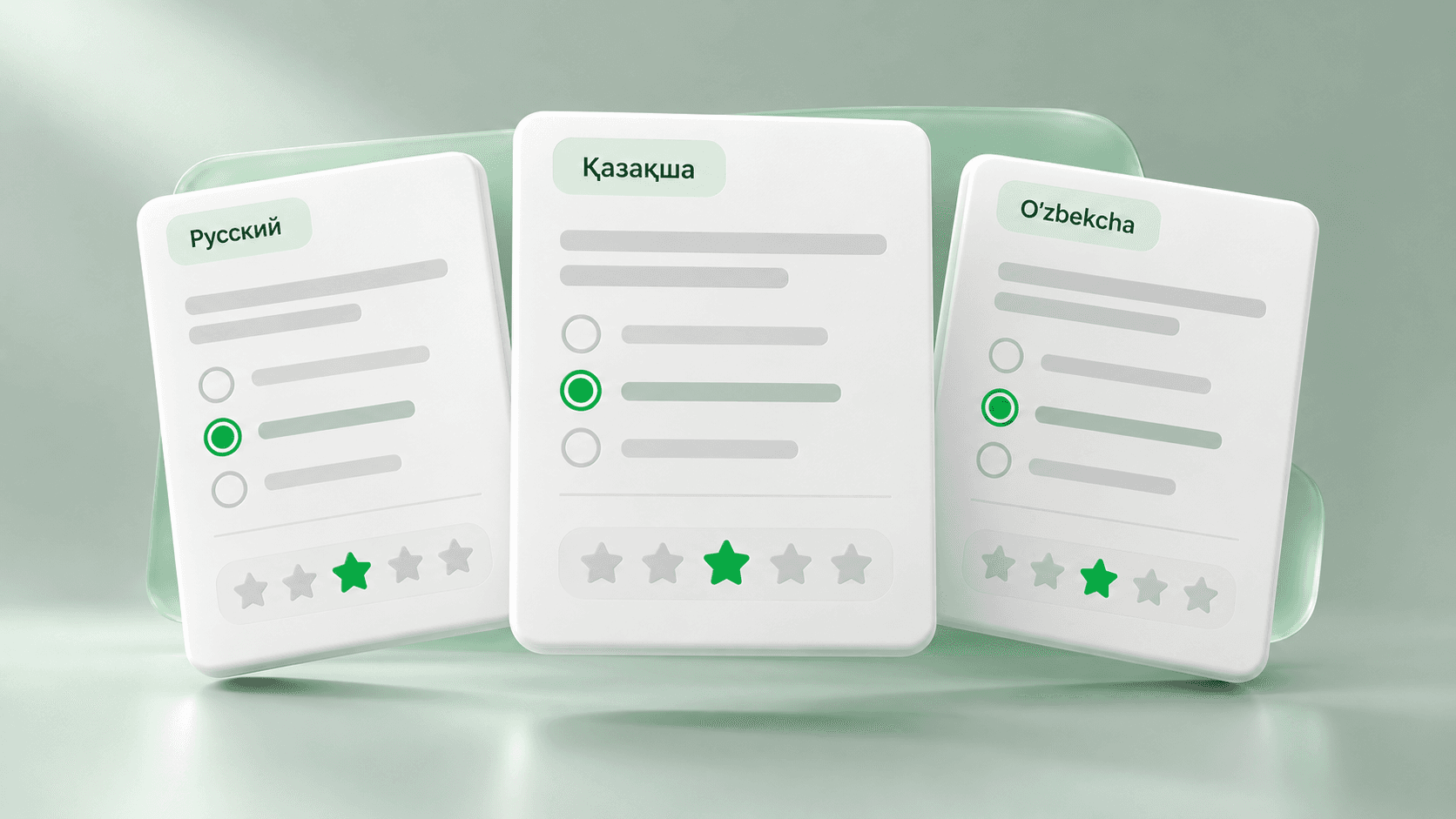
There is a classic beginner’s mistake in research: The survey is ready in Russian, the deadline is burning, and a brilliantly simple idea is born -run the text through any online translator, switch the language setting, and hit send.
A week later, the data comes back. And according to the results, 40% of respondents “didn’t understand the question” or gave answers completely unrelated to the topic. The respondents aren't strange. It’s just that translation is not localization. And data collected from a poorly translated survey lies just as confidently as well-gathered data. Only quietly.
Why Word-for-Word Translation is a Risk, Not a Cost-Saver
Machine or literal translation preserves the words, but loses the meaning, tone, and cultural context of the question. A phrase that sounds neutral in Russian can sound awkwardly formal or conversely, way too casual, when translated word-for-word into Kazakh or Uzbek. As a result, the respondent either guesses their answer or simply closes the survey halfway through. And that ruins your completion rate even further.
A separate issue is rating scales and evaluative phrasing.“Somewhat agree” and “Strongly agree” is a fine line even in one’s native language. But when translated word-for-word, this line either disappears or becomes overly sharp. The outcome: a distribution of responses that reflects the quality of the translation, not what people actually think.
Localization is Not Translation. It’s Adapting to How People Actually Talk
Proper localization doesn’t start with a translator. It starts with a native speaker who understands the research context. Phrasing is reshaped around natural, spoken language:
Not: “Please rate your level of satisfaction on a scale from 1 to 10.”
But rather a phrase someone would actually say when talking to a friend about the same product.
The difference seems subtle on paper - but it’s massive in the quality of data you end up receiving.
This applies to cultural context, too. Examples, analogies, and even light humor in the intro text that work in one market can be completely confusing in another. What brings a smile to a respondent in Moscow might cause bewilderment in Tashkent, and vice versa.
Voice Responses: When Text Isn’t the Best Format
Another key topic is voice. Part of the audience in Central Asia feels much more comfortable formulating detailed thoughts verbally than typing them out. Especially in open-ended questions, where the most valuable insights usually hide. Forcing these respondents to type a long answer is a guaranteed way to get a short “everything is fine” instead of the deep breakdown you actually wanted to hear.
Voice responses with automatic transcription solve this problem from both ends:
It’s easier and more natural for respondents to answer.
You don’t have to manually listen to hours of audio recordings. Text transcripts are generated automatically and enter the main analysis alongside regular text responses.
How to Properly Organize a Multilingual Survey
Three practical rules that save both time and data quality:
Don’t mix languages in a single wave mindlessly. Respondents should see the survey in the language they chose themselves, not guess through mixed phrasing.
Test scales separately for each language. Run a pilot version on a small test group before full launch. Minimal time spent versus the risk of ruining your entire dataset.
Tag the response language in your dataset. This allows you to compare later whether answers differ by language segment. Sometimes a variance in answers doesn't signal a real split in opinion, but rather that the phrasing in one of the languages was slightly off.
How It Works at gro.now
With gro.now, surveys can be launched in multiple languages at once within a single research project, featuring localized (not machine-translated) phrasing, as well as support for voice responses with automatic transcription. This means you can run one study simultaneously across Kazakhstan, Uzbekistan, and Azerbaijan, gather fully comparable data for each market, and never worry that part of your results is measuring translation quality instead of real customer opinions.
Multilingualism isn't just a “available in three languages” checkbox in a pricing plan. It’s the difference between research you can actually trust and research that simply looks complete.